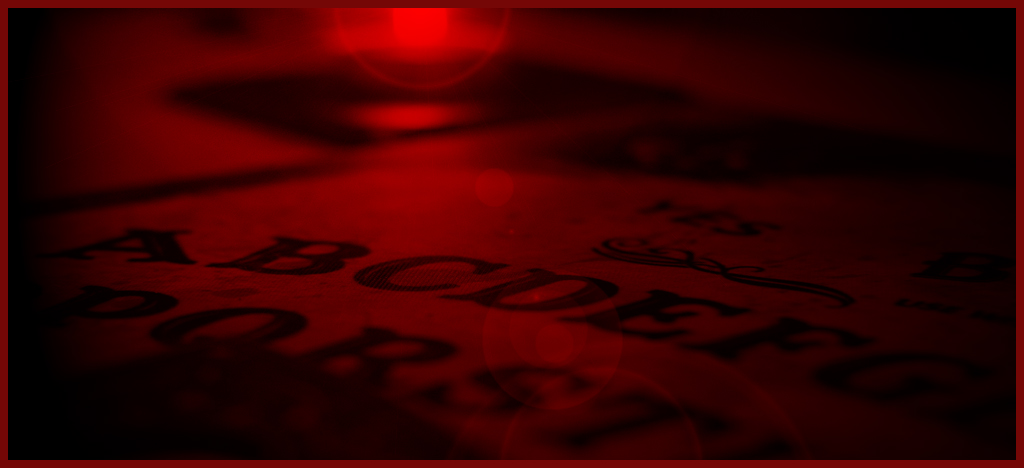
The Ouija board is a flat board with letters, numbers, and words that is used to communicate with spirits. It comes with a planchette, a small device that moves across the board and spells out messages. But where did this board come from and how did it become so popular?
A traditional Ouija board design
Origins of the Ouija board
The Ouija board is not a modern invention. It has its roots in ancient methods of automatic writing, which is the practice of writing without conscious control or intention. One of the earliest examples of this is found in China around 1100 BC, where a technique called fuji or “planchette writing” was used to contact the spirit world.
However, the Ouija board as we know it today was developed in the late 19th century in America, during the height of the spiritualist movement. Spiritualism was a belief that the dead could communicate with the living through mediums and séances. Many people were fascinated by this idea, especially after the Civil War, when many families lost their loved ones and sought comfort and closure.
The first commercial Ouija board was created by Elijah Bond, a businessman who saw the potential of selling a simple and accessible device for spirit communication. He sold the rights to his invention to Charles Kennard and his Kennard Novelty Company, who patented the Ouija board in 1892.
The name “Ouija” was supposedly derived from an ancient Egyptian word meaning “good luck”, according to the board itself. The board also claimed that it was not a toy, but a serious instrument for contacting the unseen realm.
Popularity of the Ouija board
The Ouija board became a sensation in America and beyond. It was marketed as a fun and mysterious parlour game that could provide “never-failing amusement and recreation for all the classes”. It was also seen as a way to explore one’s own subconscious mind and reveal hidden truths.
The Ouija board gained more credibility when it was used by some prominent spiritualists and writers. For example, Pearl Curran, a medium and novelist, claimed that she received messages from a spirit named Patience Worth, who dictated several books and poems through the Ouija board.
Another famous user of the Ouija board was William Butler Yeats, a Nobel Prize-winning poet and occultist. He used the Ouija board with his wife Georgie Hyde-Lees, who acted as a medium for various spirits that influenced Yeats’ poetry and philosophy.
An ornate Ouija board with a triangular shaped wooden planchette
The Ouija board also inspired fear and controversy among some religious groups and sceptics. Some Christians denounced the Ouija board as a tool of Satan and warned against its use, believing that it could invite demonic possession or deception. Some occultists also cautioned against using the Ouija board without proper knowledge or protection, as it could attract negative or harmful entities.
Some scientists and psychologists tried to explain the Ouija board phenomenon as a natural result of unconscious movements or suggestions, known as the ideomotor effect. This is when people move or act without being aware of it, influenced by their expectations or beliefs. However, this theory does not account for all the cases of accurate or meaningful information obtained through the Ouija board.
The Ouija board today
The Ouija board is still widely available today, sold by Hasbro Inc. as a classic board game. It has also become a popular subject in pop culture, especially in horror movies and stories that depict it as a source of evil or horror. Some examples are The Exorcist (1973), The Conjuring (2013), and Ouija (2014).
There are also many people who use the Ouija board not is a fun distraction like a board game, they use it for spiritual or personal reasons, either out of curiosity or faith. Some claim to have positive or enlightening experiences with the Ouija board, while others report negative or frightening ones.
Ouija Board Fun Facts: The word planchette is a French word meaning ‘little plank.” Planchettes are often heart shaped but may be almost any shape and size, they are made from many various materials including wood, stone, plastic and even thick card.
There was a court case for a murder in Britain during the 1990s during which the jury was dismissed, somehow the judge heard the jury had used a Ouija board in their hotel one night to contact the murdered victim. They tried to ask if the suspect in the court had committed the crime, it seems the answer from the board was that the accused was guilty. Amazingly, if the jury had done this in the jury room rather than a hotel the judge would have been unable to do anything as in law, the judge has no right to know what goes on in the jury room, it is totally private. As a side note, when the case was retried with a fresh jury, the accused was indeed found guilty – just as the spirit had said via the original jury’s trusty Ouija board.
Not deemed as simply a tool to contact the dead, Ouija boards were sometimes used during the first world war to contact troops fighting abroad.
Ouija boards became wildly unpopular in 1973 following the release of the movie The Exorcist, in which the board featured and was shown to be a gateway allowing evil demons into our world. Prior to this, Ouija boards were hugely popular as a game and often bought for children. It outsold many other board games including Monopoly – Interestingly enough, to this day Hasbro Inc. owns the copyrights to both the Ouija Board and Monopoly.
The Ouija board was featured in the movie, The Exorcist.
The Ouija board remains a mysterious and controversial object that sparks debate and interest among believers and skeptics alike. Whether it is a harmless game, a powerful tool, or something else entirely, is up to each individual to decide. What do you think? Let us know in the comments.