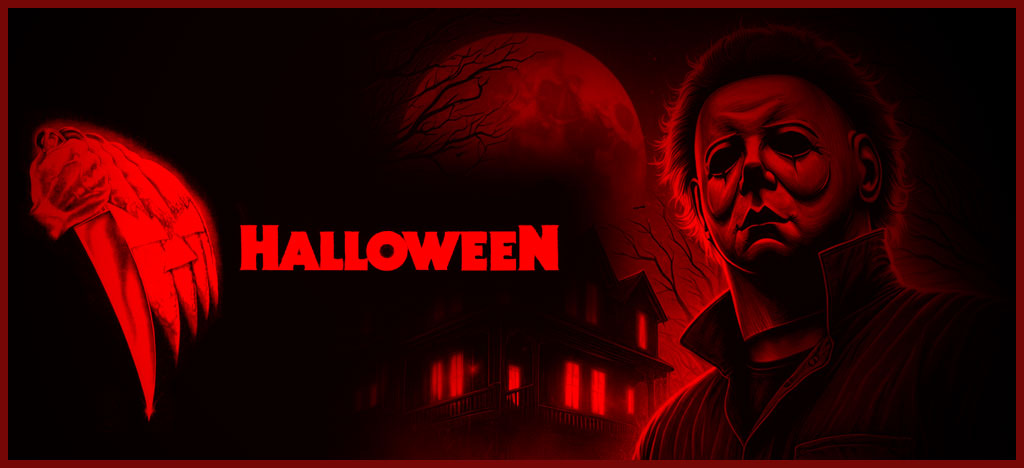
Favourite Horror Movies 4 – Halloween (1978)
You’ve probably heard of the cult movie, Halloween and Michael Myers, the iconic masked killer who stalks his victims on Halloween night.
But do you know the history and evolution of this terrifying character and his franchise? In this blog post, I’ll give you a brief overview of the Halloween movies, from the original classic to the latest reboot.
Warning! This article contains spoilers. It was created for those who have already seen the movie in question. If you have not seen the movie and plan to do so, it is suggested you do so before reading this article.

Halloween: The first Halloween movie was released in 1978, directed by John Carpenter and co-written by Carpenter and Debra Hill. It introduced us to Michael Myers, a six-year-old boy who murders his sister Judith on Halloween night in 1963. He is then sent to a mental institution, where he escapes 15 years later and returns to his hometown of Haddonfield, Illinois. There, he targets Laurie Strode (Jamie Lee Curtis), a teenage babysitter, and her friends, while being pursued by his psychiatrist Dr. Sam Loomis (Donald Pleasence). The film was a huge success, earning over $70 million on a $300,000 budget, and became one of the most influential horror movies of all time.
Halloween II (1981): This was a direct sequel to the first film, picking up right where it left off. It revealed that Laurie was actually Michael’s younger sister, who was adopted by another family after the murder of Judith. Michael follows Laurie to the hospital where she is taken after surviving his attack, and continues his killing spree. Dr. Loomis eventually catches up with him and shoots him in the eyes, causing an explosion that seemingly kills them both. The film was also a commercial hit, but received mixed reviews from critics and fans.
Halloween III: Season of the Witch (1982) was a departure from the Michael Myers storyline, as it focused on a different plot involving a sinister company that produces Halloween masks that kill their wearers. The film was intended to start a new anthology series of standalone Halloween stories, but it was poorly received by audiences who expected to see Michael Myers again. As a result, the franchise returned to its original antagonist in the subsequent films.
Personally, I believe this to be a good stand-alone 1980s horror flick, related to the Halloween franchise by its name alone. Definitely worth a watch.

Halloween 4: The Return of Michael Myers (1988) revived the character after a six-year hiatus. It revealed that Michael and Dr. Loomis survived the explosion at the end of Halloween II, but were severely injured and comatose for a decade. Michael awakens when he hears that Laurie Strode died in a car accident, leaving behind a daughter named Jamie Lloyd (Danielle Harris). He escapes from his transport and heads to Haddonfield to kill Jamie, who is living with a foster family. Dr. Loomis also returns to stop him once again. The film was well-received by fans who welcomed Michael’s comeback.
Halloween 5: The Revenge of Michael Myers (1989) continued the story of Jamie Lloyd, who developed a psychic link with her uncle Michael after he attacked her at the end of Halloween 4. She is now mute and living in a children’s clinic, where she has visions of Michael’s whereabouts. Michael returns to Haddonfield to finish what he started, while being hunted by a mysterious figure known as the Man in Black. The film was criticized for its weak plot and characters, as well as its cliffhanger ending that left many questions unanswered.
Halloween 6: The Curse of Michael Myers (1995) attempted to explain the origin of Michael’s evil and his connection to the Man in Black, who turned out to be the leader of a cult called the Thorn that worshiped Michael as their chosen one. The film also introduced Tommy Doyle (Paul Rudd), one of Laurie’s former babysitting charges who became obsessed with finding out the truth about Michael. He teams up with Dr. Loomis and Jamie’s son Steven to stop Michael and the cult from sacrificing Steven as part of their ritual. The film suffered from production problems and reshoots that resulted in two different versions: the theatrical cut and the producer’s cut, which had different endings and scenes. Neither version was well-received by critics or fans.
Halloween H20: 20 Years Later (1998) ignored the events of Halloween 4-6 and served as a direct sequel to Halloween II. It brought back Jamie Lee Curtis as Laurie Strode, who faked her death and changed her identity to Keri Tate, a headmistress of a private school in California. She has a son named John (Josh Hartnett), who is unaware of her past. On Halloween night, Michael Myers tracks down Laurie and John at their school, where he faces off with his sister for one final confrontation. The film was praised for its homage to the original film and Curtis’ performance, but criticised for its lack of originality and suspense.

Halloween: Resurrection (2002) followed up on the ending of Halloween H20, where Laurie decapitated Michael after he attacked her. It revealed that Michael had switched places with a paramedic, who was the one who was killed by Laurie. Michael then tracks down Laurie at a psychiatric hospital, where he finally kills her. He then returns to his childhood home, where a group of college students are participating in a reality show called DangerTainment, hosted by Freddie Harris (Busta Rhymes). Michael kills most of the students, while Freddie and the survivors fight back. The film was widely panned for its poor script, acting, and humour, as well as its disrespect for the legacy of Laurie Strode.
Halloween (2007) was a remake of the original film, directed by Rob Zombie. It explored the childhood and back-story of Michael Myers, who grew up in an abusive family and killed his sister, mother’s boyfriend, and school bully when he was 10 years old. He was then sent to a mental institution, where he became a patient of Dr. Loomis (Malcolm McDowell). Fifteen years later, he escapes and returns to Haddonfield to find his baby sister Laurie (Scout Taylor-Compton), who was adopted by the Strode family. The film was a box office success, but received mixed reviews from critics and fans, who praised Zombie’s vision and style, but disliked his changes to the original characters and story.

Halloween II (2009) was a sequel to the remake, which continued the story of Laurie and Michael. It showed how Laurie struggled with the trauma of her encounter with Michael, while Michael had visions of his dead mother (Sheri Moon Zombie) and a white horse that guided him to kill again. Dr. Loomis also returned, but as a greedy and selfish author who exploited Michael’s story for fame and money. The film ended with Laurie stabbing Michael repeatedly and being taken to a mental hospital, where she saw a vision of her mother and the white horse. The film was a commercial failure and received negative reviews from critics and fans, who criticized its excessive violence, lack of coherence, and departure from the original franchise.
Halloween (2018) was another reboot that ignored all the previous sequels and served as a direct sequel to the original film. It brought back Jamie Lee Curtis as Laurie Strode, who became a paranoid survivalist who prepared for Michael’s return for 40 years. She also had a strained relationship with her daughter Karen (Judy Greer) and granddaughter Allyson (Andi Matichak). On Halloween night, Michael Myers escapes from a prison bus transfer and goes on another killing spree in Haddonfield, while being pursued by Dr. Sartain (Haluk Bilginer), a former colleague of Dr. Loomis. Laurie confronts Michael in her fortified house, where she traps him in the basement and sets it on fire. The film was a critical and commercial success, praised for its homage to the original film, Curtis’ performance, and its themes of trauma and empowerment.
Halloween Kills (2021) is the sequel to Halloween (2018), which picks up right after the events of the previous film. It shows how Michael Myers survived the fire and continued his rampage in Haddonfield, while Laurie Strode was taken to a hospital with serious injuries. The film also features other characters from the original film, such as Tommy Doyle (Anthony Michael Hall), Lindsey Wallace (Kyle Richards), Marion Chambers (Nancy Stephens), and Lonnie Elam (Robert Longstreet), who form a mob to hunt down Michael. The film also explores the origins of Michael’s mask and his connection to the town. The film received mixed reviews from critics and fans, who praised its gore and action, but criticized its plot and characters.

Halloween Ends (2022) is the final instalment of the trilogy that started with Halloween (2018) and continued with Halloween Kills (2021). The film follows Laurie Strode and her granddaughter Allyson as they try to move on from their traumatic encounters with Michael Myers. However, when a new series of murders begins, they suspect that Michael is still alive and out for revenge. The film is directed by David Gordon Green and stars Jamie Lee Curtis, Andi Matichak, Rohan Campbell and James Jude Courtney.
MOVIE RATING


© Colin Lawson Books