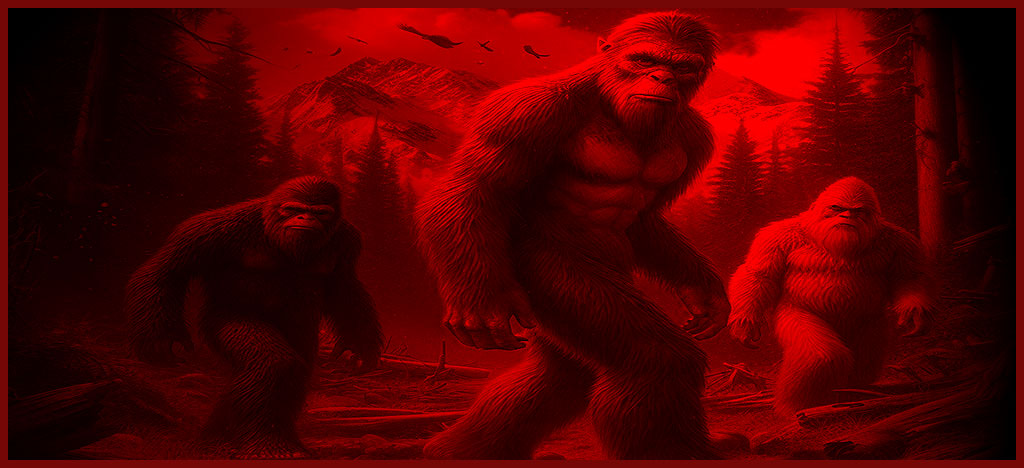
Monsters of Horror 12: The Bigfoot, Sasquatch and Yeti
Let’s explore the fascinating world of Bigfoot, Sasquatch, and the Yeti. These legendary creatures have captured our imaginations for centuries, inspiring stories, movies, and research.
Here’s a breakdown of their differences:
The Sasquatch:
– The term “Sasquatch” is widely respected and commonly used to describe the enigmatic primate/person hybrid.
– Derived from the Halkomelem dialectal word “Sésquac,” which means “wild man,” it was first used by the Coast Salish peoples in the Pacific Northwest.

– This creature is often associated with wooded areas and shares many fabled qualities with the Yeti.
The Bigfoot:
– The term “Bigfoot” is common shorthand for Sasquatch.
– It gained recognition in 1958 when Gerald Crew cast large footprints found near his bulldozer in Bluff Creek, California.

– The Bigfoot Field Researchers Organization is one of the most respected groups of Bigfoot enthusiasts.
History of the Bigfoot/Sasquatch:
The Bigfoot, also commonly referred to as Sasquatch, is a large and hairy human-like mythical creature alleged by some to inhabit forests in North America, particularly in the Pacific Northwest. The legend of Bigfoot has deep roots in American culture, but its origins trace back long before the 21st century. Indigenous tribes across Northwestern America have spoken for centuries of a furry, bipedal beast that stole from fishermen and lived in isolation.

Genzoli jokingly wrote in his September 21 column alongside the letter, “Maybe we have a relative of the Abominable Snowman of the Himalayas.” Later, Genzoli said he’d simply thought the mysterious footprints “made a good Sunday morning story.” But to his surprise, it fascinated readers. In response, Genzoli and fellow Humboldt Times journalist Betty Allen published follow-up articles about the footprints, reporting the name loggers had given to the so-called creature who left the tracks—“Big Foot.” And so a legend was born.

Anecdotal descriptions estimate a height of roughly **6–9 feet** (1.8–2.7 meters), with some descriptions having the creatures standing as tall as **10–15 feet** (3.0–4.6 meters). Some alleged observations describe Bigfoot as more human than ape, particularly in regard to the face. Common descriptions include broad shoulders, no visible neck, and long arms, which many skeptics attribute to misidentification of a bear standing upright. Some alleged nighttime sightings have stated that the creature’s eyes “glowed” yellow or red.
While enthusiasts within the pseudoscience of cryptozoology have offered various forms of dubious evidence to prove Bigfoot’s existence—including anecdotal claims of sightings as well as alleged photographs, video and audio recordings, hair samples, and casts of large footprints—the scientific consensus is that Bigfoot is more likely a combination of folklore, misidentification, and hoax rather than a living animal. Folklorists trace the phenomenon of Bigfoot to a combination of factors and sources
The Yeti:
– Unlike Sasquatch, the Yeti is an entirely different entity.

– Its origin can be traced back to pre-Buddhist Eastern civilizations, particularly in the Himalayan Mountain region.
– The Yeti is believed to be an Arctic creature resembling a bear more than an ape.
– It’s usually spotted in cold climates and has been worshipped by early indigenous people as the “Glacier Being.”
The Abominable Snowman:
– The name, The Abominable Snowman, was coined in 1921 by Henry Newman, a contributor to The Statesman newspaper, this term refers to large footprints encountered during the British Mount Everest Reconnaissance Expedition.

History of the Yeti/Abominable Snowman:
The Yeti, also known as the Abominable Snowman, is a cryptozoological phenomenon that has captured imaginations for decades. Popularized by British mountain explorers in the early 20th century, this elusive creature is said to inhabit the Himalayan mountain range in Asia.
Physical evidence purported to be from the Yeti—such as fur, bone, and skin—has been analyzed genetically, revealing that it actually comes from bears. The Asiatic black bear and two subspecies of brown bears—the Tibetan and Himalayan—are among the species that fall within the “range” of the Yeti.
The legend of the Yeti began with Western explorers gathering first-hand accounts from locals. These observations were translated into prosaic descriptions of the creature’s shape, fur color, and gait.

Despite this, the Himalayan wilderness seemed vast and inaccessible enough for an undiscovered animal to be plausible. Even famed nature writer Peter Matthiessen, during a 1973 Himalayan expedition to study blue sheep, remained open to spotting a Yeti alongside snow leopards.
Of all mythical beasts, the Yeti has received attention in actual peer-reviewed scientific journals. Articles about it have appeared in top-tier science and conservation publications.
One popular explanation for the origins of the Yeti is that it is a descendant of Gigantopithecus, a giant ape whose fossil remains have been found in India and China. These fossils date back from 3,000 years to 12 million years ago—a time when the Himalayas were rising dramatically.
In summary, while scientific evidence has debunked claims of the Yeti’s existence, its myth continues to intrigue and inspire curiosity.
The Bigfoot-Giganto Theory:
– Some researchers believe that both Sasquatch and Yeti trace their lineage back to a massive ape called Gigantopithecus Blacki.

In summary, while Sasquatch and Bigfoot are often used interchangeably (with Bigfoot being more common), Yeti is an entirely different creature associated with the Himalayan region.

© Colin Lawson Books